Ink on Everything: How the Letterpress Underground Turned a Dead Craft Into an Act of Defiance
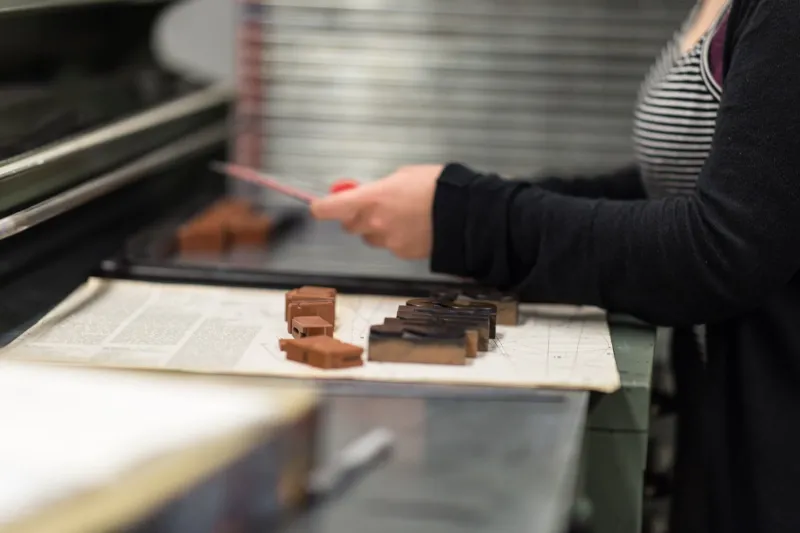
A Vandercook proof press weighs somewhere around 1,500 pounds. It doesn't have a USB port. It can't be updated. It requires physical maintenance, real skill, and the kind of patience that the internet has spent twenty years engineering out of human behavior. And right now, in repurposed warehouses and back-room studios from Portland to Philadelphia, these machines are running.
The letterpress revival isn't new as a phenomenon — craft printing has been quietly building momentum since at least the mid-2000s. But something has shifted in the last few years. What used to feel like nostalgic hobbyism has started to look more like infrastructure. Community print shops are forming. Mail-art networks are expanding. People are making things with their hands and sending them through the postal service on purpose, as a statement.
Heavy Machinery, Light Distribution
The Vandercook is the machine most people in this scene encounter first. Originally designed as a proofing press — a way for commercial printers to check their work before running a full job — Vandercooks became the workhorses of art school print departments starting in the mid-20th century. When digital replaced analog in commercial printing, the machines migrated: to university basements, to artists who bought them cheap, to community shops that saw the potential.
They're not the only option. Platen presses, tabletop Adanas, even hand-set type frames — the equipment is varied and often old, requiring practitioners to become part-time machinists. That's not incidental to the appeal. A significant number of people in this scene will tell you that learning to maintain the equipment is inseparable from learning to use it.
"You have to understand the machine to use the machine," says one Chicago-based printer who runs a cooperative studio space out of a former auto body shop on the northwest side. "There's no customer support number. You figure it out or you find someone who knows more than you do."
That knowledge-sharing ethos is one of the defining characteristics of the community. Print shops that operate as collectives — where members pay dues for access to equipment and teach each other techniques — have proliferated across mid-sized American cities in particular. Cincinnati, Richmond, Tucson, Minneapolis: these are not places you'd expect to find active letterpress communities, but they have them.
The Algorithm Can't Deboss Paper
Ask practitioners why they're doing this and you get answers that range from the practical to the almost philosophical. The practical case is straightforward: letterpress printing produces objects with genuine physical presence. The debossed impression of type into thick cotton paper is something you can feel with your fingertips. It doesn't compress into a thumbnail. It doesn't render differently on different screens. It is what it is, and what it is has weight.
The philosophical case goes further. A lot of people in this scene are explicitly framing what they do as a response to the attention economy — the infinite scroll, the engagement optimization, the way social media has restructured creative work around metrics. Letterpress printing is, by its nature, limited. You can't produce thousands of copies on a proof press in an afternoon. Distribution is physical and slow. Your reach is constrained by the number of envelopes you're willing to address.
For some practitioners, that constraint is the point. "I don't want to reach everyone," says a printer and mail-art participant based in Albuquerque. "I want to reach the right people. Sending something through the mail is an act of choosing."
Mail art — the practice of creating and exchanging handmade postal pieces — has been around since the Fluxus movement of the 1960s, but it's experiencing a genuine resurgence that overlaps significantly with the letterpress community. People are printing broadsides, postcards, small editions of poetry, and sending them to networks of correspondents they've built over years. There are mail-art calls — open invitations to participate in themed exchanges — that circulate through newsletters and small online forums, deliberately avoiding the major social platforms.
Community Shops as Third Spaces
The community print shop model deserves particular attention because it's doing something that goes beyond printing. These spaces function as third places in the classic sociological sense — neither home nor work, but somewhere you go to be around other people who care about something specific.
The LA Printmaking Society, the Arm & Cleaver in Brooklyn, Spudnik Press in Chicago — these are institutions that have built genuine communities around shared equipment and shared practice. Membership models vary: some charge monthly dues, some operate on class fees, some are nonprofits running on grants. What they share is a commitment to access — keeping the equipment available to people who couldn't afford to buy a Vandercook outright, which is most people.
The programming that happens around the printing is often as important as the printing itself. Workshops, residencies, collaborative projects, zine fairs — these shops have become organizing nodes for a broader analog culture that includes but isn't limited to letterpress.
The New Practitioners
It would be easy to paint this scene as uniformly white, educated, and nostalgic — a stereotype that clings to craft culture generally. The reality is more complicated. The community print shop model has been a deliberate vehicle for broadening access, and a number of shops have explicitly prioritized programming for communities that have been historically excluded from fine arts infrastructure.
The practitioners entering the scene now are younger, more technically diverse, and often more politically motivated than the craft revival wave of fifteen years ago. They're combining letterpress with risograph printing, screen printing, and bookbinding. They're making political broadsides and community newspapers and handmade editions of work that couldn't find a commercial publisher.
The friction hasn't gone away. It still takes time, skill, and patience to make something good on a letterpress. But that friction, for a growing number of people, is precisely what makes it worth doing.
The algorithm gets everything else. This is theirs.