Five Bucks a Box: The Flea Market Lifeline Keeping Pulp Horror Paperbacks in Print
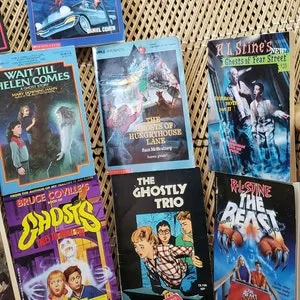
Photo: vintage horror paperback books flea market table, via i.etsystatic.com
Walk the back rows of almost any big American flea market — the swap meet in San Jose, the roadside fields of the Carolinas, the indoor year-round markets of the Rust Belt — and you'll find the table. Cardboard boxes of paperbacks, spines cracked, covers a glory of airbrushed skulls and tentacles, hand-lettered sign reading something like HORROR PAPERBACKS 5 FOR $10.
That table is doing something more important than it looks.
The Vendors Are the Catalog
Before recommendation engines, paperback racks were the discovery mechanism for American weird fiction. Cover art and a back-cover blurb did all the work. That whole economy — the lurid covers, the lightning-fast production schedules, the army of writers under house names — left behind tens of thousands of titles from the 1960s through the 1990s, most of them long out of print and invisible to any online storefront.
The people who keep them circulating are flea market vendors, many of whom are collectors first. Talk to them and you'll meet the guy in Ohio with a climate-controlled storage unit holding north of 4,000 theological horror paperbacks — demonic possession, haunted Bibles, apocalyptic priests — sorted by subgenre. You'll meet the woman outside Austin who does brisk trade in 1980s splatter paperbacks and can tell you which titles have the good covers versus the good prose (rarely the same book). You'll meet retirees who buy entire estate lots just to rescue a dozen titles from the dumpster.
These vendors aren't getting rich. They're running a distribution network for books that would otherwise cease to exist in physical form, one five-dollar bill at a time.
The Collectors and the Codes
Collecting vintage horror paperbacks has its own deep taxonomy. First printings of certain 1970s titles command serious money. Cover artists have followings — fans who hunt a specific painter's work across a dozen publishers. There are collector codes and grading standards borrowed from comic book culture, arguments over spine creases, and a brisk trade in reader copies versus shelf copies.
But the healthiest part of the scene, honestly, is the people who read them. Vendors will tell you the best customers aren't the graders — they're the teenagers who buy a stack of paperbacks with lurid covers because they look cool, and then actually read them, and come back the next month wanting more like them. That's the old paperback rack mechanic, running on pure folk transmission.
The Small Presses Step In
Here's where the story turns: some of these forgotten books are coming back into print. A wave of small presses — many run by collectors who got tired of paying collector prices to read the actual books — has spent the last decade reprinting obscure 1970s and '80s weird fiction, often with brand-new cover art that winks at the lurid tradition. Paper editions, limited runs, sold mostly direct or through the same independent bookstores and conventions where the scene congregates.
The pipeline works like this: a collector finds something great in a flea market box, champions it online or in a zine, a small press reprints it, and suddenly a book that existed in maybe 3,000 decaying copies is back in circulation. Sometimes the original author — or their estate — gets paid. Sometimes the byline was a house name and nobody knows who wrote it, which becomes its own research obsession.
Why the Physical Version Matters
You could read most of this stuff as scans. Plenty do. But the paperback was engineered as a disposable object of desire — the cover art, the cheap paper, the rack presence — and that's part of the art. Holding a beat-up 1976 paperback with a cover painting that promises more than any book could deliver is a different experience than a PDF. It's context. It's folk culture you can shelve.
So here's your assignment: the next time you pass a flea market, find the paperback table. Bring five bucks. Ask the vendor what's weird. You'll get a two-minute lecture, a personal recommendation, and probably a better reading experience than anything an algorithm would've suggested.
Just don't haggle over the first printing. The vendors remember.